Recovery Notes
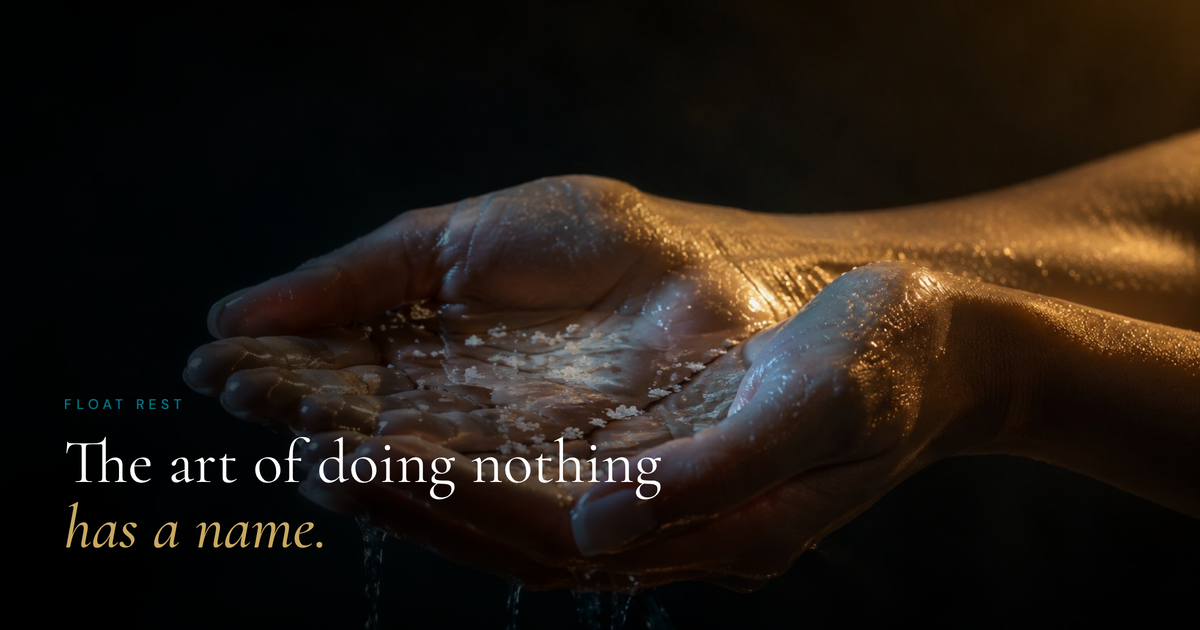
The art of doing nothing has a name
Niksen, float REST, and the rarest hour you can give yourself this winter.
You sit down to rest and reach for your phone. That is most people's version of rest, and it is not really rest at all.
Genuine stillness has quietly become one of the hardest things to find. The day is full of input from the moment you wake. Notifications, screens, conversations, the low hum of things that need doing. Even downtime tends to be a quieter kind of busy. By this point in winter, with short days and a full calendar, most of us are running flat out without a real pause anywhere in it.
The Dutch have a word for it: niksen. It means doing nothing on purpose, with no goal attached. Not scrolling, not unwinding in front of something, not resting so you can be more productive afterwards. Just nothing, for its own sake. It sounds simple, and it is surprisingly difficult, because almost everything in a day is pointed the other way.
Doing nothing, properly, is harder than it sounds. And that is exactly the point.
What float REST actually is
Float REST is sixty minutes of as close to nothing as you can get. You lie back in body-temperature water, held completely by its buoyancy, in the dark and the quiet. No phone. No screen. No weight to hold, no temperature to notice, nothing asking for your attention. For an hour, there is genuinely nowhere to be and nothing to do.
The first few minutes can feel strange. The mind, used to a constant stream of input, goes looking for some. Then, usually, it stops looking. What is left is the kind of stillness a lot of people have not felt in a long time.
Stillness is a skill
This is the part most people do not expect. Stillness is a skill, not a switch you flick. The more often you practise it, the more easily you settle into it, which is why a float is rarely a one-off for the people who try it. We guide your first one so you know what to expect and how to use the hour, and over time you learn to drop into that quiet faster. Like anything you practise, you get better at it.
That is the difference between floating somewhere and floating here. The water is the same everywhere. The method around it, and a space built to let you actually let go, is not.
Why winter suits it
Winter is the season that asks you to slow down, and most of us override it and push through to spring. The Fleurieu in the cold months is quiet, the light is low, and the pull is inward. A float fits that rhythm rather than fighting it. It is an hour of warmth and dark in the middle of a cold, demanding stretch of the year, and it is one of the few hours where the only thing on the agenda is nothing.
If you cannot remember the last time
You could, in theory, find stillness anywhere. In practice almost nobody does, because the world is built to keep hold of your attention. Float REST works because the room is built for the opposite.
If you cannot remember the last time you did nothing, take that as the reason to.
Where to Start
The First Visit
Sauna and Float REST. Ninety minutes. An easy way to feel the space and the rhythm.
Book Your First VisitThis article is general in nature and is not medical advice. Mind Over Matter Practice does not diagnose, treat, cure, or prevent any disease or condition. The experiences described are part of a wellness and recovery practice and should not replace care from a qualified medical practitioner.