
NeurOptimal Neurofeedback
Train the brain.
Everything else follows.
Your brain isn't broken. It has just settled into patterns that may not serve you anymore. NeurOptimal doesn't diagnose anything or push your brain toward a goal. It simply holds up a mirror, and lets the brain do what it's brilliant at: adapt.
NeurOptimal is a one-of-a-kind Dynamical Neurofeedback system. It reads your brain's electrical activity 256 times a second and, whenever it picks up a shift, drops a tiny interruption into the music you're listening to. Your brain notices the cue, recognises the pattern, and naturally reorganises toward something more efficient and settled. No protocols, no diagnosis, and nothing required from you but to show up and lie down.
System
NeurOptimal Dynamical
Neurofeedback
Duration
40 minutes
How it works
Sensors read brain activity
Music gives real-time feedback
Effort required
None. Relax, listen, rest
Recommended
A series works best
Most do a course of sessions
Suitable for
All ages, no diagnosis needed
Your session
What to expect
Sensor set-up
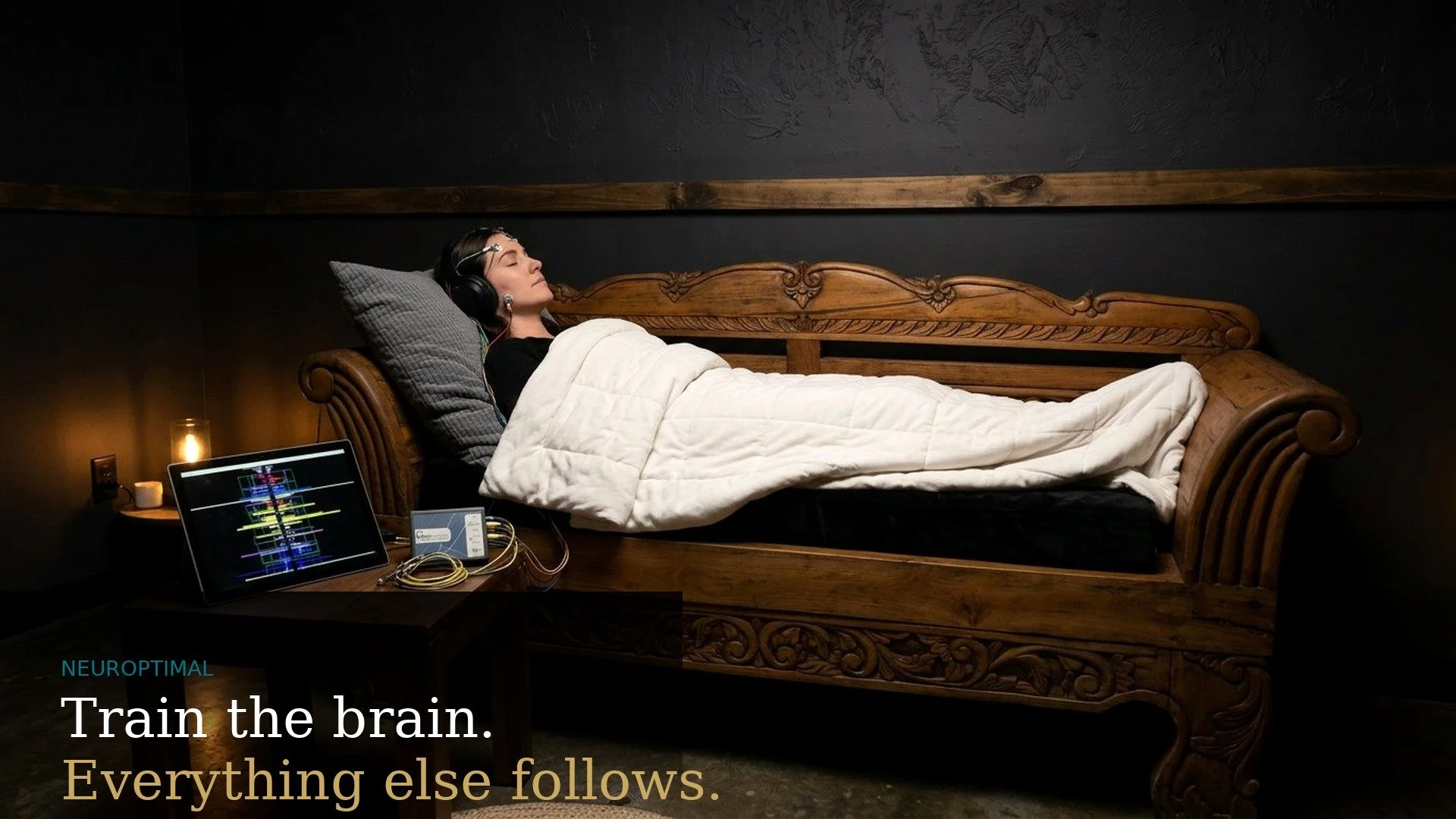
We place two small sensors on the sides of your head and clip a few onto your ears. These only read the gentle electrical activity of your brain. Nothing is ever sent in. They listen, they don't stimulate or push anything.
Recline and listen
You settle onto the Balinese daybed with a blanket and pillow, put the headphones on, and just listen to music. Nothing to do, nothing to concentrate on, nothing to achieve. Rest, doze, or let your mind drift. The system does the work.
Real-time feedback
While you listen, the software watches your brain's patterns 256 times a second. Each time it notices a shift, it slips a subtle interruption into the music. Your brain hears it, registers what just happened, and quietly self-corrects. This happens hundreds of times across the 40 minutes, completely below your conscious awareness.
Afterwards
Most people leave calmer, clearer and more grounded. Some feel pleasantly tired, a sign the brain's been busy and the body's ready for rest. The effects tend to build over the following day or two, and each session builds on the last, which is why most people do a series rather than a one-off.
Why people book it
What people come for
Everyday stress and a busy mind
Better, more restful sleep
Focus and mental clarity
A calmer, steadier baseline
Performance and being at your best
Winding down and resilience
NeurOptimal is a general wellness system that supports the brain's own ability to self-regulate. It doesn't diagnose or treat medical conditions. If you're managing a health condition, please keep working with your treating practitioner.
How it works over time
It builds with a series
First shifts
Most people notice something within the first handful of sessions. Commonly it's sleeping better, feeling more rested, a steadier mood, less reactivity and a clearer head. Early on the changes are often subtle and tend to build through the week between sessions.
A new baseline
Across a longer series, the patterns the brain has been settling into start to feel like the new normal. That calmer, clearer state becomes more of a default than something you have to work at. For general wellbeing and everyday stress, this is usually the sweet spot.
Keeping it going
For longer-standing or more deeply set patterns, people often keep going past that point, and the gains keep compounding. Once you've done a series, occasional booster sessions are a nice way to maintain and build on where you've got to.
Research-backed
The science
Most neurofeedback is linear. It assesses the brain, decides which frequencies are too high or low against population norms, and trains the brain toward a more average pattern. That needs an assessment, a practitioner setting protocols, and regular reassessment, and it treats the brain as something to be corrected toward an external standard.
NeurOptimal works from a different idea entirely. It treats the brain as an intelligent, self-organising system that already knows how to regulate itself and just needs good information about what it's doing. It provides that through real-time feedback in the music, with no diagnosis and no protocols, and without telling the brain what to do. Because nothing external is being forced, the system simply adapts to your brain rather than the other way around.
The brain reshapes itself in response to repeated experience. That's neuroplasticity, the nervous system's knack for reorganising based on the information it gets. NeurOptimal taps straight into that. Each little interruption in the music is a piece of information about what the brain just did, in that exact moment. Repeated hundreds of times a session and across a series, the brain gradually updates its habits toward something more efficient and flexible.
The usual analogy is learning a language. Once the brain's learned a pattern it doesn't really forget it, it keeps it in reserve, and like any skill it benefits from the odd top-up. That's why booster sessions are handy once you've finished an initial run.
A lot of everyday stress and broken sleep comes down to a nervous system that's learned to sit in a higher state of activation than the moment actually calls for. The brain keeps running old patterns that once made sense but now just burn energy and keep you wired.
NeurOptimal doesn't target any of that directly. By giving the brain accurate, real-time information about its own activity, it supports the nervous system's own ability to notice when it's stuck in those patterns and ease back toward a steadier baseline. People very commonly describe sleeping better and feeling less reactive over a series. We're describing what people report and how the system works, not making a claim about treating any condition.
Sleep is one of the most consistent things people mention improving, often as a flow-on from a more settled nervous system rather than anything targeted directly. As the brain gets better at moving smoothly between gears of activation and rest, a lot of people find their focus and clarity come along for the ride. Athletes, performers and professionals use NeurOptimal for exactly that edge: a calmer, sharper, more efficient brain doing its thing. It's an active and genuinely interesting area of research, and that performance angle is what a lot of our clients come in for.
Full research references on the NeurOptimal science page →
Go further
Pair it with a protocol
NeurOptimal lands best when the nervous system is already calm and receptive. Arriving off the back of one of our protocols, with the body already settled, deepens the whole thing.
The Ritual
An hour in the float then an hour of massage brings the nervous system right down. A beautiful state to walk into a NeurOptimal session from.
View The Ritual →Reset Journey
Our flagship: a full contrast cycle then a float. The thermal work and the float settle the body before you train the brain.
View the Reset Journey →Forge
Our contrast protocol. A sauna and guided plunge runs the nervous system through stress and recovery, settling it nicely before a session.
View Forge →Mind Over Matter Practice is a science-led recovery and wellness studio. We don't diagnose, treat, or replace medical care. If you have a health condition, are pregnant, or have any concern, please consult your doctor before booking.