
Let's get scientific
NeurOptimal Neurofeedback
How it works
Mind Over Matter Practice does not claim to cure disease. NeurOptimal is a general wellness system, not a medical treatment. This page explains the neuroscience behind neurofeedback and what the peer-reviewed literature supports. For clinical concerns, always work alongside your treating practitioner.
The brain is not a fixed structure. It is a living, dynamic system that is constantly reorganising itself in response to experience. This is neuroplasticity, and it is the foundation on which neurofeedback rests. When you give the brain accurate information about its own activity in real time, it uses that information to reorganise toward greater efficiency. That is all neurofeedback does. That turns out to be enough.
A 2025 comprehensive review published in Psychiatry and Clinical Neurosciences Reports synthesised findings from 65 studies, evaluating neurofeedback across ADHD, PTSD, depression and anxiety from 2000 to 2024. The conclusion: neurofeedback shows promising and growing clinical evidence across these conditions, with particular strength in ADHD and PTSD, and a strong mechanistic rationale grounded in well-understood neurophysiology (Jubair et al., 2025).
What the brain is actually doing during a session
Your brain produces electrical activity continuously. Different frequencies of this activity are associated with different states: delta with deep sleep, theta with drowsy or creative states, alpha with calm alertness, beta with active thinking, and higher frequencies with focused cognitive effort. The balance and organisation of these frequencies across brain regions determines how efficiently the brain shifts between states, regulates emotions, focuses attention and processes experience.
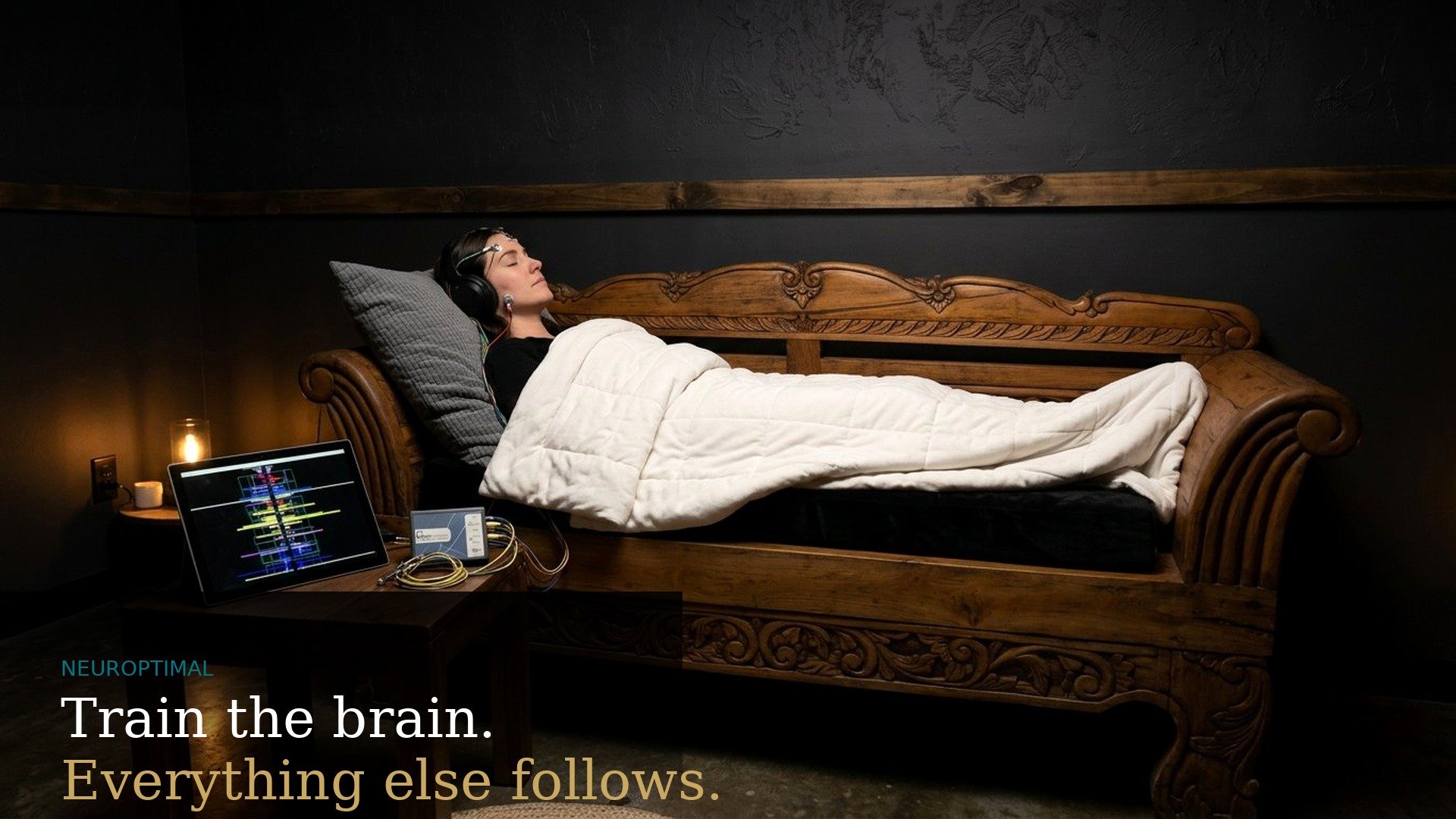
During a NeurOptimal session, sensors placed on the scalp read this electrical activity 256 times per second. The software analyses the signals across multiple frequency bands simultaneously. When it detects a sudden shift or turbulence in the brain's electrical patterns, it delivers a brief interruption in the music you are listening to. The brain hears this cue, notices the shift that triggered it, and naturally self-corrects. This happens hundreds of times across a 40-minute session, entirely outside your conscious awareness.
Marzbani, Marateb and Mansourian (2016) reviewed neurofeedback comprehensively in Basic and Clinical Neuroscience, describing the operant conditioning mechanism through which the brain learns to produce more organised electrical patterns through repeated feedback. Enriquez-Geppert, Huster and Herrmann (2017) reviewed EEG neurofeedback as a tool to modulate cognition and behaviour in Frontiers in Human Neuroscience, documenting the breadth of cognitive and behavioural effects achievable through this mechanism.
What makes NeurOptimal different: dynamical versus linear systems
Most neurofeedback systems work linearly. They assess the brain against population norms, identify frequencies that deviate from average, and then train the brain to produce more or less of specific frequencies through targeted protocols. This requires a diagnosis, expert protocol selection, and ongoing adjustment by a practitioner. Because the brain is being pushed toward an externally defined goal, over-training a state is a genuine risk and side effects are documented.
NeurOptimal operates on a fundamentally different model developed by Drs Valdeane and Susan Brown at Zengar Institute. Rather than comparing your brain to population norms and pushing it toward average, NeurOptimal views the brain as an intelligent self-organising dynamical system. It does not tell the brain what to do. It simply provides the brain with accurate information about what it is doing, and allows the brain to use that information to reorganise itself. No protocols. No diagnosis. No external goal.
Because nothing is being pushed in a predetermined direction, there are no side effects from over-training. The system adapts to your brain's activity in real time, individualising the feedback microsecond by microsecond to wherever your brain is in that moment. Ros, Baars, Lanius and Vuilleumier (2014) published a systems neuroscience framework for understanding how neurofeedback tunes pathological brain oscillations in Frontiers in Human Neuroscience, providing the theoretical grounding for why real-time feedback to the brain's own activity is effective across such a wide range of presentations.
NeurOptimal provides the brain with accurate information about its own activity so it can self-organise. No diagnosis, no protocols, no pushing the brain toward an externally defined average. The brain does the work itself.
Zengar Institute, Dynamical Neurofeedback framework, developed by Drs Valdeane and Susan BrownPTSD, trauma and the dysregulated brain
In PTSD, the brain's fear regulation circuitry becomes dysregulated in specific and well-documented ways. The amygdala becomes hyperactive. The prefrontal cortex and hippocampus, which normally regulate the amygdala's fear response, reduce in volume and activity. The result is a nervous system that remains in a state of threat-detection that no longer corresponds to actual present-moment danger.
Van der Kolk et al. (2016) published a randomised controlled study of neurofeedback for chronic PTSD in PLOS ONE, finding significant reductions in PTSD symptom severity following neurofeedback training. This remains one of the most cited controlled studies in the field. A 2024 systematic review and meta-analysis published in Frontiers in Psychiatry updated the evidence base, examining all available randomised controlled trials of neurofeedback for PTSD and finding that neurofeedback reduced PTSD symptoms from pre to post-treatment on both the Clinician-Administered PTSD Scale and the PTSD Checklist with a high quality of evidence rating (Voigt et al., 2024).
The mechanism is consistent with what NeurOptimal does. By providing the dysregulated brain with accurate real-time information about its own oscillatory patterns, the system supports the nervous system's natural capacity to recognise when it is running threat-state patterns and return to a more regulated baseline. Not through suppression, but through genuine reorganisation.
Neurofeedback reduced PTSD symptoms from pre to post-treatment on both the Clinician-Administered PTSD Scale and the PTSD Checklist with a high quality of evidence rating across randomised controlled trials.
Voigt et al., Frontiers in Psychiatry, 2024, Systematic Review and Meta-analysisADHD, focus and cognitive regulation
ADHD is characterised by dysregulated oscillatory brain activity, particularly excess theta waves relative to beta waves in regions associated with attention and executive function. Neurofeedback for ADHD trains the brain to shift this ratio toward more organised patterns, improving the brain's capacity to sustain attention, inhibit impulsive responses and regulate behaviour.
The American Academy of Pediatrics has endorsed neurofeedback as a Level 1 best-practice intervention for children with ADHD. Enriquez-Geppert, Huster and Herrmann (2017) reviewed the evidence base specifically for EEG neurofeedback as a cognitive modulation tool, documenting consistent effects on attention, working memory and cognitive flexibility. A 2025 review in Psychiatry and Clinical Neurosciences synthesised 65 studies and confirmed that ADHD has the strongest and most consistent evidence base for neurofeedback of any condition reviewed (Jubair et al., 2025).
For NeurOptimal specifically, the dynamical approach means clients with ADHD presentations do not need a formal diagnosis or a specific protocol. The brain's own dysregulation is the signal the system responds to, making it accessible across the full spectrum of attention and focus difficulties from clinical ADHD to general cognitive underperformance.
Sleep, anxiety and the nervous system
Disrupted sleep and anxiety share a common feature: the nervous system has difficulty shifting from states of activation into genuine rest. The brain maintains a level of arousal that prevents deep sleep onset, early sleep maintenance, or produces shallow, fragmented sleep that fails to restore.
A 2024 systematic review and meta-analysis published in Frontiers in Neuroscience examined the effect of neurofeedback interventions on sleep quality and insomnia across randomised clinical trials, finding positive effects on self-perceived sleep quality and insomnia symptoms (Recio-Rodriguez et al., 2024). The mechanism is consistent with the broader neurofeedback model: as the brain learns to shift more efficiently between arousal states through repeated feedback, the transition into restorative sleep becomes more natural and reliable.
For anxiety, the evidence base is growing. A real-world study of 593 participants found that 69% of those presenting with anxiety scores in the abnormal range moved to healthy score ranges following neurofeedback training. Improvements were also documented in attention, executive function and general health measures (JMIR Formative Research, 2022). Luctkar-Flude and Tyerman (2022) explored the impact of nonlinear dynamical neurofeedback specifically on post-cancer cognitive impairment and cancer-related fatigue in Integrative Medicine Reports, finding meaningful improvements in cognition and fatigue through the NeurOptimal protocol.
Cognitive enhancement, ageing and peak performance
Neurofeedback's applications extend well beyond clinical populations. Athletes, performers, executives and anyone seeking to optimise cognitive function have been using neurofeedback for performance enhancement for decades. The mechanism is the same: a brain that has learned to organise its electrical activity more efficiently is a brain that focuses better, recovers faster, and performs with greater consistency under pressure.
Marcos-Martinez et al. (2021) published research in Entropy demonstrating that neurofeedback training based on motor imagery strategies increases EEG complexity in elderly populations, reflecting greater neural flexibility and adaptability with age. Greater EEG complexity is associated with better cognitive function, more efficient neural processing and greater resilience to cognitive decline.
Renton, Tibbles and Topolovec-Vranic (2017) reviewed neurofeedback as a form of cognitive rehabilitation therapy following stroke in PLOS ONE, finding evidence for improvements in attention, memory and functional cognition. The underlying principle, that feedback about the brain's own activity supports its natural capacity to reorganise toward better function, applies whether the starting point is clinical impairment, normal ageing, or the pursuit of performance above baseline.
Stressor controllability and why the setting matters
One of the references Dex draws on in his practice is Meine, Meier, Meyer and Wessa (2021), who examined the neural correlates of stressor controllability in humans in NeuroImage. Their finding is directly relevant to how NeurOptimal works at Mind Over Matter: the perception of control over a stressor fundamentally changes the brain's neurological response to it.
This is why the NeurOptimal environment matters. You are reclining on a comfortable daybed, in a private room, in a space designed for recovery. You know what is happening, you understand the mechanism, and at any point you can end the session. The brain is receiving feedback about its own activity in a context of complete safety and control. This is not a minor detail. It is the condition under which the brain is most capable of genuine reorganisation rather than defensive adaptation.
References
- Jubair et al. Neurofeedback: applications, advancements, and future directions. Psychiatry Clin Neurosci Rep. 2025.
- Voigt JD, et al. Systematic review and meta-analysis of neurofeedback and its effect on posttraumatic stress disorder. Front Psychiatry. 2024;15:1323485.
- Recio-Rodriguez JI, et al. Neurofeedback to enhance sleep quality and insomnia: a systematic review and meta-analysis of randomized clinical trials. Front Neurosci. 2024;18:1450163.
- Enriquez-Geppert S, Huster RJ, Herrmann CS. EEG-neurofeedback as a tool to modulate cognition and behavior: a review tutorial. Front Hum Neurosci. 2017;11:51.
- Marzbani H, Marateb HR, Mansourian M. Neurofeedback: a comprehensive review on system design, methodology and clinical applications. Basic Clin Neurosci. 2016;7(2):143-158.
- Van der Kolk BA, Hodgdon H, Gapen M, et al. A randomized controlled study of neurofeedback for chronic PTSD. PLoS One. 2016;11(12):e0166752.
- Ros T, Baars BJ, Lanius RA, Vuilleumier P. Tuning pathological brain oscillations with neurofeedback: a systems neuroscience framework. Front Hum Neurosci. 2014;8.
- Luctkar-Flude M, Tyerman J. Exploring the impact of nonlinear dynamical neurofeedback on post-cancer cognitive impairment and cancer-related fatigue. Integr Med Rep. 2022;1(1):196-204.
- Marcos-Martinez D, et al. Neurofeedback training based on motor imagery strategies increases EEG complexity in elderly population. Entropy. 2021;23:1574.
- Renton T, Tibbles A, Topolovec-Vranic J. Neurofeedback as a form of cognitive rehabilitation therapy following stroke: a systematic review. PLoS One. 2017;12(5):e0177290.
- Meine LE, Meier J, Meyer B, Wessa M. Don't stress, it's under control: neural correlates of stressor controllability in humans. Neuroimage. 2021;245.
- Murayama K. A reward-learning framework of knowledge acquisition. Psychol Rev. 2022;129(1):175.