
Hyperbaric Oxygen
More oxygen.
Deeper recovery.
At normal pressure your blood is already carrying about as much oxygen as it can hold. Sitting in a pressurised chamber changes that, letting extra oxygen dissolve into places your red blood cells can't easily reach.
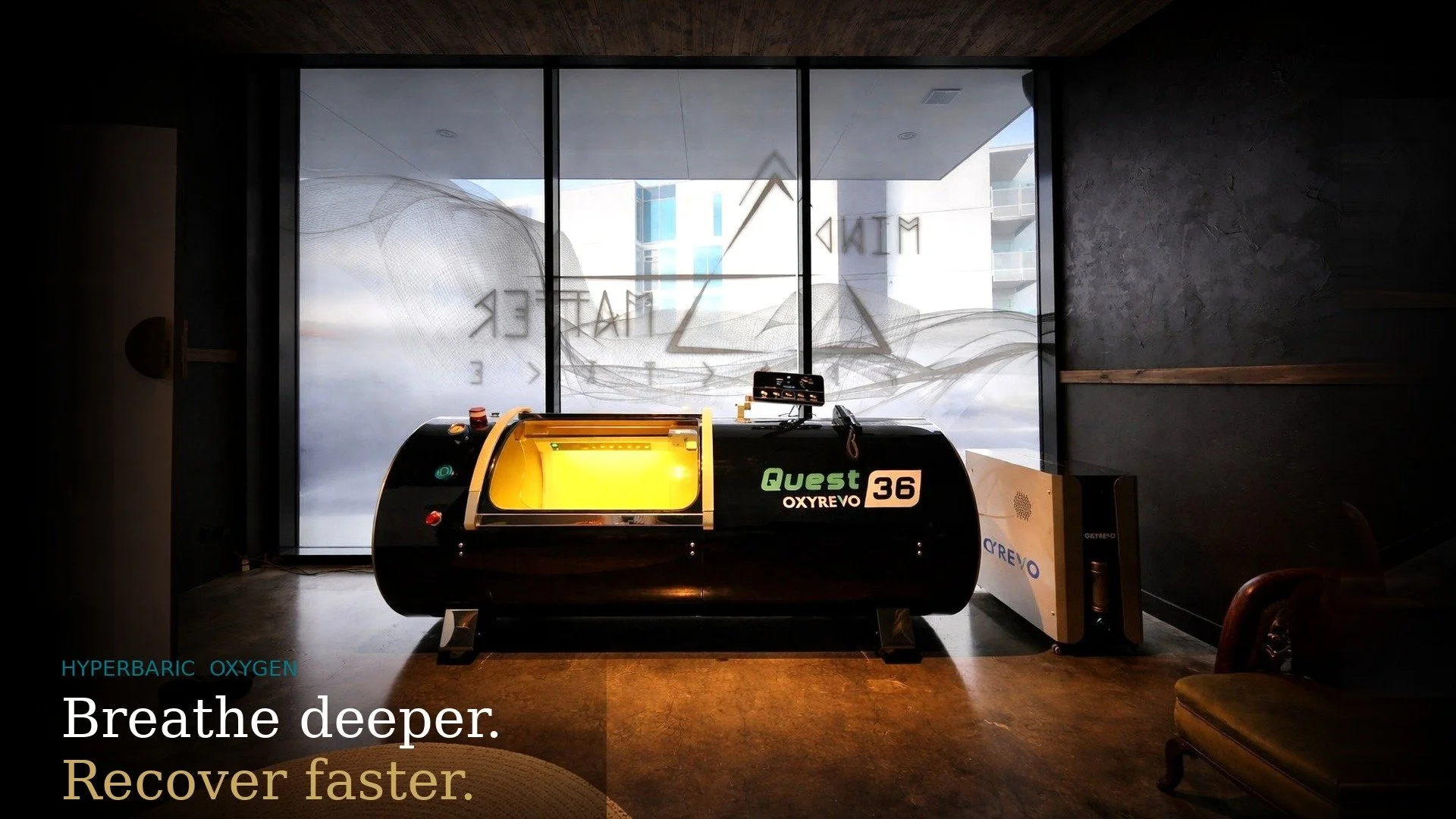
We use the Quest 36 OxyRevo chamber, running at up to 1.5 ATA on 98% oxygen. At that pressure more oxygen dissolves directly into the plasma and other fluids in the body. People come to us for it as a recovery and wellbeing session, a quiet hour that tends to leave them feeling clearer and more rested. It's one of the modalities you genuinely can't find elsewhere on the Fleurieu.
Chamber
Quest 36 OxyRevo
Duration
60 minutes
Pressure
Up to 1.5 ATA
Oxygen
98% concentration
Capacity
Single person
Setting
Private, guided
session
Who it's for
Why people book it
Recovery
A quiet hour built around rest and recovery. People who train hard, work long, or just feel run down book it to give the body a calm, oxygen-rich environment to recover in. Many pair it with contrast or a float.
Performance & training
Athletes and active people use it as part of how they recover between sessions. Hyperbaric oxygen has been studied in sport for its links to recovery and reduced training soreness, and it slots neatly into a regular routine.
Clarity & wellbeing
Most people find the hour itself deeply restful, and describe coming out clearer-headed and more settled. It's a simple, screen-free hour with nothing asked of you but to rest and breathe.
If you're managing a health condition or recovering from surgery, please talk to your doctor before booking. We're a recovery and wellness studio, not a medical hyperbaric facility, and we don't treat medical conditions.
Your session
What to expect
Arrival
We'll settle you in and, if it's your first time, walk you through how the chamber works and what the hour will feel like. Cotton clothing is best, and you'll need to leave any petroleum-based products off your skin beforehand.
Into the chamber
The Quest 36 OxyRevo is a single-person chamber set up to be comfortable for the full hour. You can read, listen to something or just rest. Whatever feels right to you.
Pressurising
The chamber pressurises gently over a few minutes. You'll feel a mild pressure in your ears, much like coming in to land on a plane, and a swallow or a yawn clears it straight away. Once you're at pressure it settles and you can relax into it.
An hour at pressure
At 1.5 ATA breathing 98% oxygen, far more oxygen dissolves into your plasma than you'd ever get at normal pressure. The session runs for 60 minutes, and most people find it genuinely restful, often a bit calm and clear-headed.
Coming back down
The chamber depressurises gradually over a few minutes and then you're done. A lot of people notice more energy, a clearer head and less physical tension over the hours that follow.
Why people come back
What people notice
Feeling rested and recovered
A calmer, clearer head
Recovery support after training
More energy through the day
A quiet, screen-free hour
Less physical tension afterwards
Research-backed
The science
At normal atmospheric pressure the haemoglobin in your red blood cells is already close to fully loaded with oxygen, so simply breathing harder doesn't add much. Pressure changes the picture. Under Henry's Law, more gas dissolves into a liquid as pressure rises, so at 1.5 ATA more oxygen dissolves straight into the blood plasma and other fluids. This is the well-understood physics the whole modality is built on.
A lot of research has looked at how raised oxygen availability interacts with the body's inflammatory signalling and recovery processes. We'll point you to that literature rather than make promises about your body: hyperbaric oxygen is an active area of study, and we describe what it's been investigated for, not what it will do for any individual. If you're managing a diagnosed condition, that's a conversation for your doctor.
One area researchers have explored is how repeated sessions affect blood vessel growth and the delivery of oxygen to tissue, including the signalling molecule VEGF. This is studied science, and it's part of why hyperbaric medicine exists in clinical settings for specific medical purposes. What we offer is a wellness recovery session, not that clinical treatment, and we'd always point anyone with a medical need toward an appropriate medical provider.
In athletic settings, studies have investigated hyperbaric oxygen as a recovery tool between hard training, looking at things like soreness and how quickly people feel ready to train again. The proposed idea is that the extra dissolved oxygen supports the body's aerobic energy systems. It's a promising and active area of research, and it's the angle most of our active clients are interested in.
Full research references on the Hyperbaric science page →
Go further
Stack it with the rest
Hyperbaric works well on its own, and even better stacked with the modalities that prime the body beforehand. Pair it yourself, or build it into a bigger recovery visit.
Reset Journey
Our flagship protocol: a full contrast cycle then a float. Add a hyperbaric session to make a complete recovery visit out of it.
View the Reset Journey →Forge
Our contrast protocol: 30 minutes of sauna into a guided cold plunge. A great way to get the body moving and primed before you settle into the chamber.
View Forge →The Ritual
Our float and massage protocol. Follow your hyperbaric session with an hour in the float and an hour of massage for a full afternoon of deep recovery.
View The Ritual →Mind Over Matter Practice is a science-led recovery and wellness studio. We don't diagnose, treat, or replace medical care. If you have a health condition, are pregnant, or have any concern, please consult your doctor before booking.