
Biological Age Testing
How old is your body
really?
Your chronological age is how many years you've been alive. Your biological age is how old your body is at the cellular level, and the two can differ by years depending on how you've lived. For the first time, that's something you can actually measure.
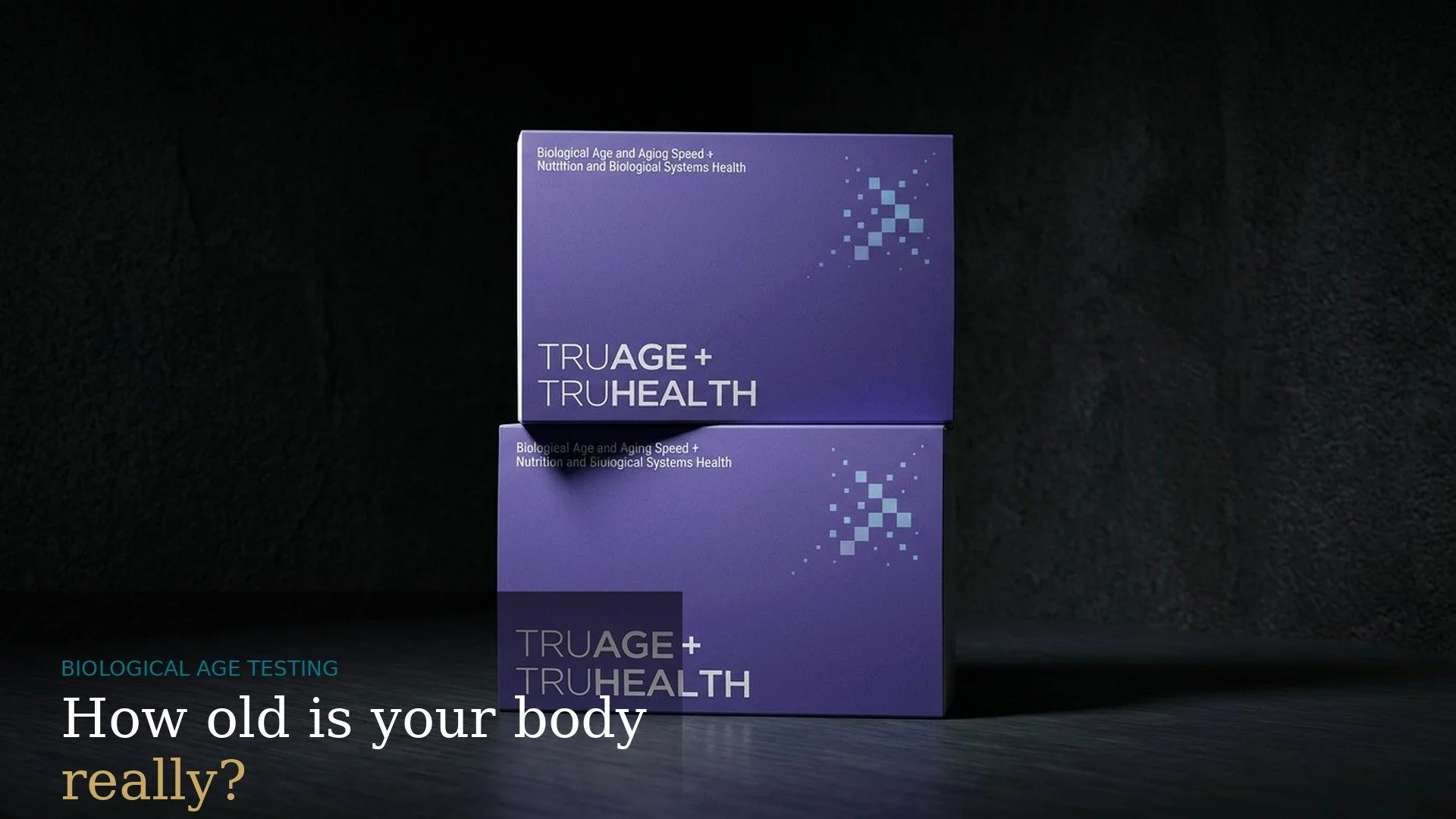
We bring you the TruAge+ TruHealth kit by TruDiagnostic, one of the most advanced epigenetic age tests available to the public, and we handle the awkward parts for you here on the Fleurieu. No ordering from overseas, no shipping a sample to the US yourself, no waiting on customs. Most importantly, Dex takes your sample properly in clinic, so you're not risking a failed home collection and another three-month wait on a re-test. When your results come back we print the full report and a summary for you to collect.
postage & printed reports
By enquiry. A deposit secures your booking and kit. Collection by appointment.
Kit
TruAge+ TruHealth
by TruDiagnostic
Sample
Finger prick blood spot
collected in clinic
Measures
180+ biomarkers
across the report suite
Turnaround
Several weeks
from lab receipt
We handle
Sourcing, collection,
postage & printing
Collection
Taken by Dex in clinic
done right first time
Price
$1,595
Deposit required
How it works
The full service
Appointment and sample collection
You come in for a short appointment where Dex collects your sample using TruDiagnostic's finger-prick method. It takes a few minutes and is essentially painless. We prepare and post your sample to TruDiagnostic's certified laboratory. A deposit secures your booking and kit at this stage.
Laboratory analysis
TruDiagnostic analyses your sample and generates your reports, covering biological age, pace of ageing, organ-system ages and a wide panel of longevity and nutritional biomarkers. Results come back several weeks after the lab receives your sample, complete with TruDiagnostic's built-in explanations and recommendations.
Your printed results
When your results arrive we print the full report along with a summary, and you collect both from the studio. That covers biological age, pace of ageing, organ-system ages and the full biomarker panel, with the explanations and personalised recommendations TruDiagnostic includes throughout. The reports are written to be read directly by you.
Acting on your results
TruDiagnostic's reports come with their own guidance built in. For any individual medical, nutritional or supplement decisions based on your results, the right person is your GP or an appropriately qualified practitioner who can consider your full health picture. Our role is to get you the test, take the sample properly and put the results in your hands. We don't interpret your results or direct your care.
What the test measures
Inside the TruAge+ TruHealth report
Biological age vs chronological age
Pace of ageing (DunedinPACE)
Biological age of 11 organ systems
Telomere length
Immune system age and cell composition
Nutritional and metabolic biomarkers
Inflammation and oxidative stress
Antioxidant and nutrient status
How lifestyle shows up in your epigenetics
Direct, or through us
What we actually add
Buying the kit direct
You can order TruAge+ TruHealth from TruDiagnostic yourself, collect your own finger-prick sample at home and ship it to the US. It works well for plenty of people. The catch is the collection: if a home sample is insufficient or fails, and it does happen, you're back to ordering again and waiting out another multi-week turnaround.
Through Mind Over Matter
We source the kit so there's no overseas ordering or customs to deal with, and Dex takes your sample properly in clinic, so it's done right the first time and you're not gambling your result and a three-month wait on a shaky home draw. We handle postage in both directions, and when your results land we print the full report and a summary for you to collect. Local, handled, done once.
The science
What epigenetic age actually measures
Your DNA sequence is fixed from birth. What changes through life is how your genes are expressed, and epigenetics is the study of those changes that happen without altering the underlying DNA. DNA methylation is the main mechanism these tests read: a methyl group attaches to specific sites on the DNA and influences how genes are expressed. These patterns shift in fairly predictable ways with age, and they're also influenced by lifestyle, environment, stress, diet and exercise. By reading a large number of these sites at once, the test estimates a biological age that a standard blood panel can't.
Two people born the same year can have quite different biological ages, because how you've lived shows up at the cellular level. That's the appeal of an epigenetic test: it gives you a measurable baseline rather than a guess, and because lifestyle influences these markers, it's something you can re-measure over time to see whether changes you've made are moving the needle. We'll let the research and TruDiagnostic's own materials speak to what the numbers mean, rather than making health predictions for you.
Knowing your biological age is one thing. Knowing how fast you're ageing right now is arguably more useful. DunedinPACE is a measure of your current pace of ageing: for each calendar year that passes, roughly how many biological years is your body moving through? A score above 1.0 reads as ageing faster than a year per year, below 1.0 as slower. It's the metric most sensitive to recent lifestyle change, which is why people who track it tend to retest periodically.
The kit includes SYMPHONYAge, which estimates the biological age of 11 individual organ systems rather than a single overall number, including the brain, heart, liver, lungs, kidneys and immune system. Most people don't age uniformly, so one system can read older or younger than your overall figure. It's one of the more interesting parts of the report, and TruDiagnostic breaks each system down for you.
Curious about your number?
$1,595 · Kit, in-clinic collection, postage both ways and your printed reports · By enquiry, deposit required
Enquire NowMind Over Matter Practice is a science-led recovery and wellness studio. Biological age testing is provided as a facilitated collection service: we source the kit, take your sample and provide your results. We don't diagnose, interpret your results, or provide medical, nutritional or treatment advice. Results and recommendations are provided by TruDiagnostic. For decisions about your health, please consult your GP or an appropriately qualified practitioner.