
Let's get scientific
Float REST
How it works
Before diving into the physiology behind Restricted Environmental Stimulation Therapy (REST), it's important to understand that Mind Over Matter Practice is committed to exploring and enhancing various states of the nervous system. We don't claim to cure diseases. What we do is highlight what the research shows, explain the mechanisms behind it, and let your own body tell the rest of the story. Our focus is on guiding you through different nervous system states. and the float tank is one of the most powerful tools we have for doing that.
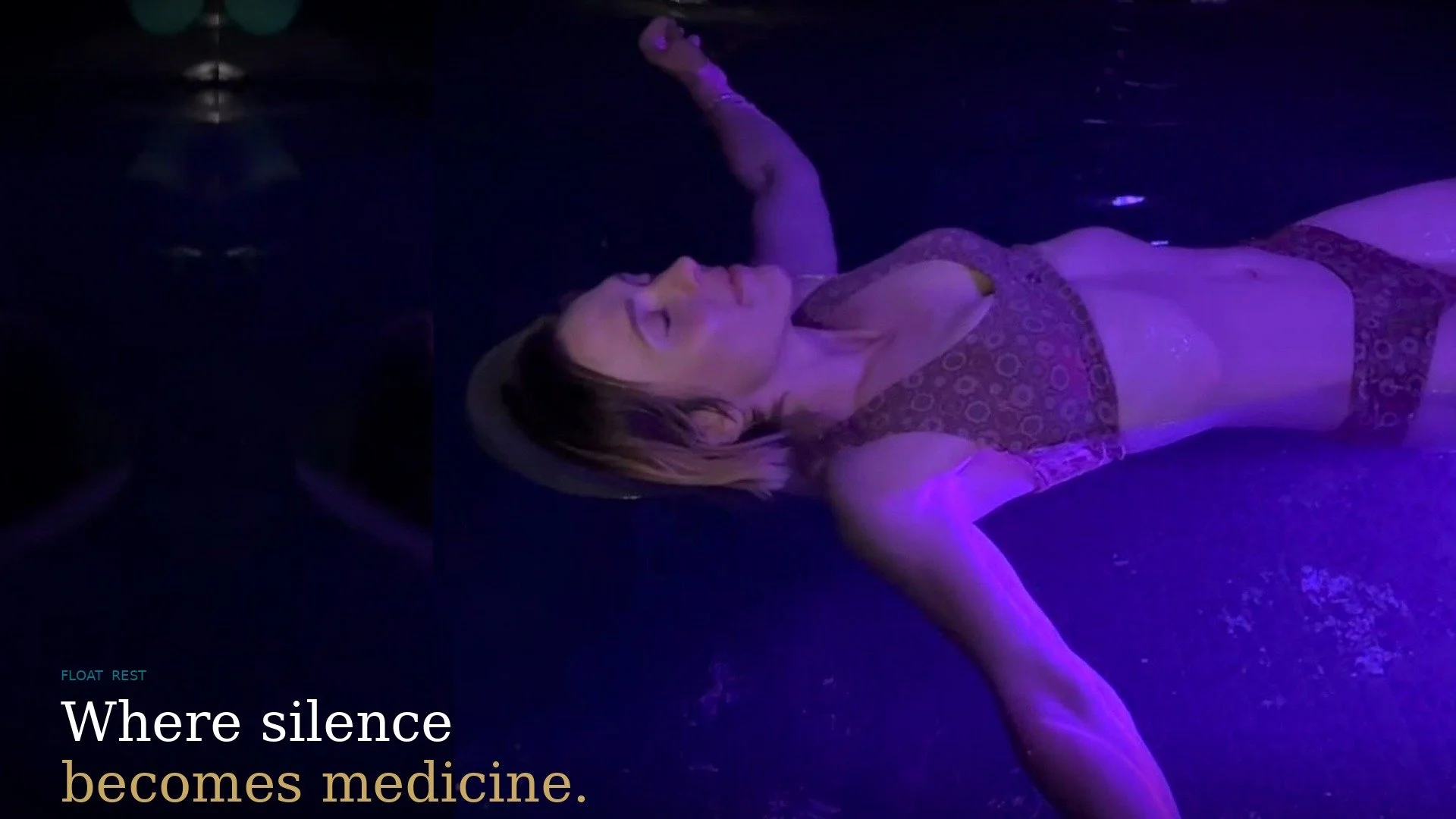
When you step into the float cabin and close the door, something unusual happens. The usual flood of sensory input. light, sound, gravity, temperature differential, the feeling of air on your skin. disappears. Your nervous system has been processing thousands of signals every second. Suddenly it has almost nothing to process. What happens next is remarkable, and it's well-documented.
A 2025 systematic review of 63 studies covering 1,838 participants. the largest review of the floatation-REST evidence base ever published. confirmed positive effects across pain, athletic performance, stress, mental wellbeing and clinical anxiety. This isn't fringe science anymore. The evidence base has been building for decades, and it keeps getting stronger.
What happens to your nervous system
The reduced sensory input triggers your body to shift from sympathetic dominance to parasympathetic dominance. This is the state most of us spend most of our day trying to escape. This is the "rest and digest" branch of your autonomic nervous system, and it's where healing happens. The body stops allocating resources to threat response and redirects them toward recovery.
This shift isn't subtle. A 2022 study published in Frontiers in Neuroscience measured cardiovascular changes during floatation-REST using wireless waterproof sensors. the first time this had been done with real-time data during a session. The results were clear: significant drops in both systolic and diastolic blood pressure, reduced breathing rate, and a measurable increase in high-frequency heart rate variability. HRV is one of the most reliable markers of parasympathetic activity and vagal tone we have. Float REST moved it significantly in the right direction. These changes were consistent across both anxious and non-anxious participants.
This is directly relevant to what we do at Mind Over Matter. We measure your blood pressure before and after every session. What you see in those numbers, the drop from entry to exit, is not placebo. It's your autonomic nervous system doing exactly what the research predicts.
At the hormonal level, cortisol. the primary stress hormone. decreases significantly during REST. This happens through suppression of the hypothalamic-pituitary-adrenal (HPA) axis. The HPA axis is your stress response system command centre. When external sensory input drops to near zero, the brain's threat-detection circuitry quiets, and the HPA axis follows.
Float REST significantly lowers blood pressure, slows breathing rate and increases high-frequency HRV. direct, real-time physiological evidence of parasympathetic activation.
Flux et al., Frontiers in Neuroscience, 2022Anxiety, depression & the brain under pressure
The mental health evidence for floatation-REST has been building steadily. Reduced amygdala activity, improved serotonin production, enhanced connectivity between the prefrontal cortex and limbic system. These are not vague wellness claims. They are documented neurological changes that translate into measurable improvements in mood, reduced rumination and better emotional regulation.
In 2024, the first randomised controlled trial examining repeated sessions of floatation-REST in clinically anxious and depressed individuals was published in PLOS ONE. Seventy-five participants were randomised to six sessions of floatation-REST or an active comparator. The results showed floatation-REST was safe, well-tolerated, and associated with an anxiolytic and antidepressant effect that persisted for over 48 hours after each session. Dropout rates were low. Adherence was comparable to established behavioural interventions for anxiety and depression. which is significant, because people actually kept showing up.
For those carrying PTSD, the mechanism is particularly relevant. The overactive amygdala, stuck in threat-detection mode, calms significantly in the float environment. The absence of external stimuli removes the triggers that keep it firing. Session by session the nervous system learns that stillness is safe.
Six sessions of floatation-REST are safe, well-tolerated and produce an anxiolytic and antidepressant effect that persists for over 48 hours in clinically anxious and depressed individuals.
Garland et al., PLOS ONE, 2024. Randomised Controlled TrialPain, muscle recovery & athletic performance
Gravity is a constant compressive force on the body. Most people have never experienced what it feels like to have that load removed. not partially, but almost entirely. In the float cabin, the density of the Epsom salt solution suspends your body without effort. Joints decompress. Muscles that have held tension for years finally let go. The combination of mechanical unloading, reduced inflammation, and the release of endorphins produces pain relief that is difficult to achieve through other means.
The 2025 systematic review confirmed pain as one of the strongest areas of evidence for floatation-REST. 11 dedicated pain studies, covering fibromyalgia, tension headaches, stress-related musculoskeletal pain and chronic pain conditions. The results were consistently positive across them.
For athletes and high-performance individuals, floatation-REST has been shown to improve perceived recovery following high-intensity resistance exercise. reduced muscle soreness, improved mood state, faster readiness to train again. The float cabin has a legitimate place in a performance recovery protocol, not just a wellness one.
Blood pressure & cardiovascular function
The blood pressure response to float REST is one of the most consistently documented findings in the research. Multiple studies have shown significant reductions in both systolic and diastolic blood pressure following float sessions, with the effect being particularly pronounced in individuals with hypertension. The mechanism is straightforward. parasympathetic activation lowers peripheral vascular resistance, the heart rate steadies, and the cardiovascular system settles into a calmer operating state.
This is one of the reasons we take blood pressure before and after every session. The numbers don't lie, and over repeated sessions the downward trend becomes meaningful. particularly for clients who come in carrying chronically elevated baseline readings.
Sleep
Many clients report sleeping better in the days following a float session. The mechanism makes sense. lower cortisol, reduced hyperarousal, a nervous system that has been given a genuine opportunity to reset. The reduction in HPA axis activity that occurs during REST supports the body's natural circadian rhythms and reduces the arousal state that keeps people awake or wakes them too early.
It's worth being honest here. The 2025 systematic review found that the evidence for floatation-REST as a treatment for clinical sleep disorders specifically is limited. What the evidence does support is sleep improvement as a secondary benefit of stress reduction and parasympathetic activation. which is how most of our clients experience it. You don't float to fix insomnia. You float to address the underlying nervous system state that's driving it.
Magnesium & the 900kg question
There's a reason we use 900kg of pharmaceutical-grade Epsom salts and not the minimum required to float. Epsom salt is magnesium sulphate. In a solution this concentrated, magnesium is absorbed transdermally through the skin throughout the entire session. Magnesium is involved in over 300 enzymatic processes in the body. muscle relaxation, nerve signalling, sleep regulation, energy production. Most adults are chronically low in it.
There's also a direct connection between magnesium and the HPA axis. Magnesium deficiency is associated with increased stress reactivity and elevated baseline cortisol. The transdermal absorption during REST compounds the cortisol-reducing effect of the sensory deprivation itself. The two mechanisms work together. The brain quiets the HPA axis from the top down. The magnesium supports the same process from the bottom up.
Altered states, theta waves & the dissolving boundary
Some of what happens in the float tank is harder to quantify but no less real. As the nervous system quiets, the brain tends to drift into a theta wave state. the frequency associated with the hypnagogic period between wakefulness and sleep, and with deep creativity, insight and what researchers sometimes call "dissolution of body boundaries." People lose track of where their body ends and the water begins. Time distorts. The usual mental chatter stops.
A 2024 study compared floatation-REST with bed-REST in a dark, quiet room. Floatation-REST produced significantly greater dissolution of body boundaries and distortion of subjective time. and those altered states were directly associated with reductions in anxiety and increases in relaxation. The weightlessness isn't incidental. It's part of the mechanism.
For high-stress, high-cognitive-load individuals. the people who most need to stop. the float tank offers something that no other intervention quite does: a genuine, enforced, physiologically-supported pause. Not meditation with a distracted mind wandering. Not sleep with its own demands. Something in between that has documented neurological and physiological consequences.
References
- Lashgari E, Chen E, Gregory J, Maoz U. A systematic review of flotation-restricted environmental stimulation therapy (REST). BMC Complement Med Ther. 2025;25:230.
- Garland MM, Wilson R, Thompson WK, et al. A randomized controlled safety and feasibility trial of floatation-REST in anxious and depressed individuals. PLoS One. 2024;19(6):e0286899.
- Flux MC, Fine TH, et al. Exploring the acute cardiovascular effects of Floatation-REST. Front Neurosci. 2022;16:995594.
- Turner JW, Fine TH, Ewy GA, Westbrook T. The presence or absence of light during flotation REST: effects on plasma cortisol, blood pressure, and mood. Biofeedback Self Regul. 1990;15(4):327-331.
- Kjellgren A, Sundequist U, Norlander T, Archer T. Effects of flotation-REST on muscle tension pain. Pain Res Manag. 2001;6(4):181-189.
- Bood SÅ, Kjellgren A, Norlander T. Treating stress-related pain with flotation REST. Pain Research and Management. 2009.
- Bood SA, et al. Effects of flotation REST on stress-related muscle pain: are 33 sessions more effective than 12? Social Behavior and Personality. 2006;34(5):493-504.
- van Dierendonck D, Te Nijenhuis J. Flotation REST: effects on well-being and anxiety. J Health Psychol. 2005;10(3):487-492.
- Feinstein JS, Khalsa SS, Yeh H, et al. Examining the short-term anxiolytic and antidepressant effect of floatation-REST. PLOS ONE. 2018;13(2):e0190292.
- Fine TH, Turner JW. The effect of brief restricted environmental stimulation therapy in the treatment of essential hypertension. Behav Res Ther. 1982;20(6):567-570.